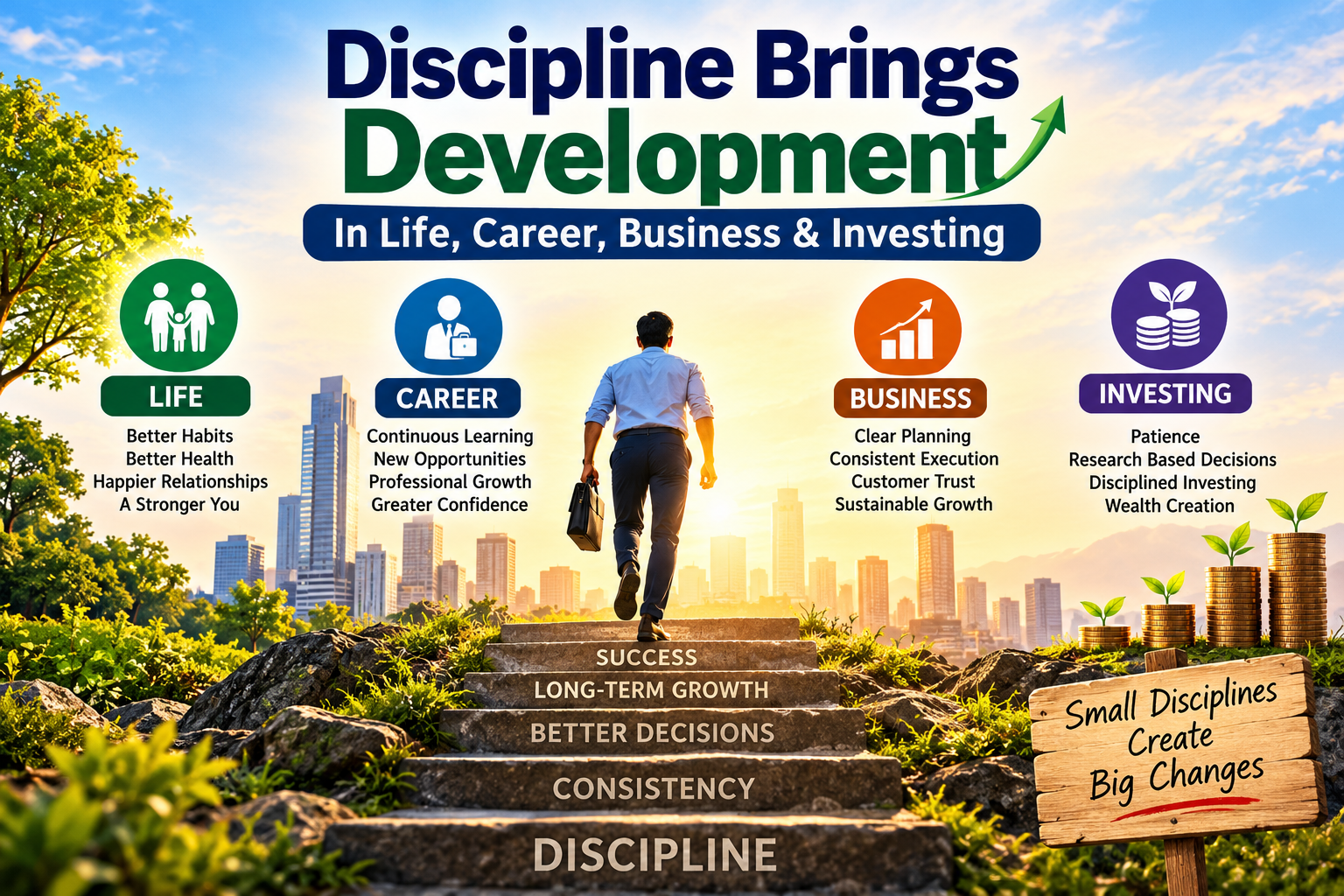
Introduction: Small Disciplines Create Big Changes
Everyone wants to be successful.
Some people want a better career. Some want to build a profitable business. Others want financial freedom, a peaceful family life or long-term wealth through investing.
But there is one common factor behind many lasting achievements: discipline.
Talent can give you a head start. Knowledge can help you make better decisions. Opportunities can open doors. But discipline helps you keep moving forward, especially when motivation disappears and results take time.
Discipline brings development. Discipline builds character. Discipline turns intentions into action.
You do not need to change your entire life in one day. You need to start making better decisions consistently, one day at a time.
1. Discipline in Life: Become the Person You Want to Be
A successful life is not built only through major achievements. It is also shaped by everyday habits.
Waking up on time, respecting commitments, taking care of your health, spending time with family, learning new things and managing your emotions may seem like small activities. But when repeated consistently, they can make a meaningful difference.
Example
Imagine two people who want to improve their health.- Person A exercises for two hours on one day, then does nothing for the next two weeks.
- Person B walks for 30 minutes every day and gradually improves their routine.
Person B is more likely to develop a sustainable habit because consistency matters more than occasional bursts of enthusiasm.
The same principle applies to reading, learning, relationships and personal development.
Remember: You do not need a perfect day every day. You need habits that help you get back on track after a difficult day.
2. Discipline in Your Career: Skills Grow Through Consistency
A successful career is rarely built overnight.Professionals who continue learning, improve their communication, meet deadlines, accept feedback and take responsibility often build stronger foundations for long-term growth.
You may not receive recognition immediately. Your salary may not increase every year. A promotion may take longer than expected. However, disciplined effort can improve your skills, reliability and ability to handle greater responsibilities.
Example
Consider two employees with similar qualifications.One employee learns only what is required for today's job. The other spends 30 minutes each day improving professional skills, studying industry developments and learning from mistakes.
After one year, the second employee may have developed stronger capabilities and be better prepared for new opportunities.
The outcome is never guaranteed, but the process creates an advantage.
Practical career habits
- Start your day with your most important task.- Learn one useful skill every month.
- Meet commitments and communicate delays honestly.
- Ask for feedback instead of avoiding criticism.
- Review your progress every week.
Your career grows when your daily habits support your long-term ambitions.
3. Discipline in Business: Consistency Builds Trust
Starting a business is exciting. Building a sustainable business requires discipline.Business owners must manage cash flow, control expenses, serve customers, follow up with prospects, maintain records and make decisions even when the market is challenging.
A business may generate high revenue in one month and struggle in the next. Sustainable development requires more than occasional sales; it requires reliable systems and consistent execution.
Example
Imagine two business owners.The first contacts customers only when sales are falling. The second follows a daily schedule for customer service, prospect follow-ups, learning and relationship building.
The second business owner is creating a repeatable process rather than depending entirely on urgency or luck.
Over time, consistent service and honest communication can help strengthen customer trust and referrals.
Five disciplines for business growth
1. Financial discipline: Monitor revenue, expenses, cash flow and outstanding payments.2. Customer discipline: Respond on time and deliver what you promise.
3. Marketing discipline:Promote your services consistently instead of only when business is slow.
4. Learning discipline: Study your industry, competitors and changing customer needs.
5. Execution discipline: Set clear weekly targets and review the results.
A business does not become strong simply because its owner works long hours. It becomes stronger when that effort is directed towards the right priorities.
4. Discipline in Investing: Wealth Is Built Through Decisions, Not Excitement
Investing is one area where discipline can be especially important because emotions often influence financial decisions.When markets rise, investors may become overconfident and invest without understanding the risks. When markets fall, fear may push them to abandon a carefully considered plan.
A disciplined investor focuses on goals, risk tolerance, diversification, time horizon and the quality of financial decisions rather than reacting to every market movement.
Example 1: The disciplined SIP investor
Suppose an investor decides to invest ₹5,000 every month through a Systematic Investment Plan (SIP), based on their financial goals and ability to bear risk.Instead of changing the plan every time the market rises or falls, the investor reviews the investment periodically and checks whether it remains suitable.
Over time, regular contributions can help build an investment corpus. However, returns are market-linked, and neither profits nor a particular corpus is guaranteed.
Example 2: The emotional investor
Another investor frequently buys stocks because of social media recommendations, becomes excited when prices rise and sells in panic when prices fall.Even if this investor occasionally makes a profit, inconsistent decisions and inadequate research can increase the risk of poor outcomes.
The difference is not simply how often each investor checks the market. It is whether their decisions follow a thoughtful process.
Five disciplines every investor should consider
- Goal discipline: Know why you are investing and when you may need the money.- Research discipline: Understand an investment before committing money.
- Risk discipline: Avoid concentrating too much of your portfolio in a single investment without considering the consequences.
- Behavioural discipline: Avoid making impulsive decisions based only on fear, greed or market noise.
- Review discipline: Monitor investments periodically and rebalance when appropriate for your goals and risk profile.
Discipline does not mean never changing an investment. It means making changes for considered reasons rather than reacting impulsively.
In investing, patience is valuable—but patience should always be supported by research, risk management and periodic review.
5. Discipline in Personal Finance: Control Your Money Before It Controls You
Financial development begins with understanding how money enters your life, where it goes and how you prepare for the future.A person may earn a high salary but struggle financially because spending rises with income. Another person with a more modest income may build a stronger financial foundation through careful budgeting and regular saving.
Income matters, but how you manage it matters too.
A simple example
Consider a person who earns ₹50,000 per month.If they regularly track expenses, maintain an emergency fund, manage debt responsibly and invest an affordable amount towards long-term goals, they can gradually build better financial habits.
Another person earning the same amount may spend without a plan and depend on borrowing whenever an unexpected expense occurs.
Their financial outcomes may differ significantly over time.
The figures and circumstances will vary, but the principle remains useful: financial discipline helps you give your money a purpose.
Simple habits for financial discipline
1. Track your monthly income and expenses.2. Separate essential expenses from discretionary spending.
3. Build an emergency reserve appropriate to your circumstances.
4. Avoid unnecessary high-cost debt.
5. Save and invest according to your goals and risk capacity.
6. Review insurance protection and financial commitments periodically.
You do not need to become wealthy before developing financial discipline. Developing financial discipline is one way to work towards greater financial stability.
6. Discipline During Difficult Times: Your Real Test Begins When Motivation Fades
It is easy to follow a routine when everything is going well.The real challenge comes when business is slow, a job application is rejected, an investment portfolio falls in value or personal responsibilities increase.
During such periods, many people abandon their plans because progress seems invisible.
But difficult periods can also be opportunities to review your approach, strengthen your skills and improve your decision-making.
Discipline does not mean blindly continuing a failing strategy. It means maintaining your principles while being willing to change your methods when evidence suggests that a change is needed.
For example:
- A business owner may revise an ineffective marketing strategy while continuing to serve customers consistently.
- A professional may change career direction while maintaining a learning routine.
- An investor may reassess an investment after new information changes its fundamentals.
- A person facing financial pressure may adjust their budget rather than ignore the problem.
Stay committed to your purpose, but remain flexible about your process.
7. Powerful Quotes About Discipline and Consistency
Here are some well-known ideas that capture the importance of disciplined action.We are what we repeatedly do. Excellence, then, is not an act, but a habit.
— Commonly attributed to Aristotle; the wording comes from a modern summary of the idea in his ethical philosophy.
It does not matter how slowly you go as long as you do not stop.
— Commonly attributed to Confucius.
The secret of getting ahead is getting started.
— Mark Twain is commonly credited with this saying, although the attribution is disputed.
And here is a simple reminder to carry into everyday life:
“Motivation may help you start, but discipline helps you continue.”
The goal is not to collect inspiring quotes. It is to turn the ideas behind them into actions you repeat.
8. How to Build Discipline in 30 Days
You do not have to transform your life overnight. Start with a manageable routine and build gradually.Week 1: Create awareness
Identify one area where you want to improve: health, career, business, personal finance or investing.Write down your current habits and identify one change that would make a meaningful difference.
Week 2: Build a small routine
Choose one action you can realistically repeat.Examples include reading for 15 minutes, reviewing expenses for 10 minutes, contacting a few customers or studying a professional skill. Make the habit specific and easy to track.
Week 3: Track consistency
Record whether you complete your chosen action each day. If you miss a day, identify the reason and resume your routine instead of abandoning the entire plan.Week 4: Review and improve
Ask yourself:- What did I do consistently?
- What interrupted my routine?
- What results or improvements have I noticed?
- What should I change for the next month?
Do not measure success only by the number of days completed. Measure whether your routine is helping you move towards your goal.
9. The Compound Effect of Small Disciplines
A small improvement may not seem significant today. But repeated actions can influence your skills, habits, relationships and financial decisions over time.Reading regularly can expand your knowledge. Consistent customer follow-ups can strengthen business relationships. Regular saving can help build financial reserves. Research-based investing can improve the quality of your decisions.
This is the broader lesson of the compound effect: small actions can accumulate, although the results depend on circumstances, the quality of the actions and factors beyond your control.
You do not have to outperform everyone today. Focus on improving your own process.
A useful question to ask yourself every evening is: “Did my actions today bring me closer to the person I want to become?” If the answer is yes, even in a small way, you are moving in the right direction.
Conclusion: Discipline Is a Daily Choice
Success in life, career, business and investing rarely depends on one decision alone. It is influenced by many decisions made over months and years.Discipline helps you keep promises to yourself, learn from mistakes, manage your resources and remain focused on meaningful goals.
You will have difficult days. You may lose motivation. Your plans may need to change. None of these experiences means that you have failed.
The important thing is to learn, adjust and continue with a better process.
Start small. Be consistent. Review your progress. Stay patient.
Discipline brings development because the habits you practise today help shape the opportunities you create tomorrow. Your future is not determined by one perfect day. It is influenced by the choices you keep making.
Take Action Today
Choose one area of your life that needs improvement. Set one realistic goal, decide what action you will take tomorrow and commit to reviewing your progress after 30 days.Do not wait for the perfect time. Begin with the time and resources you have.
Explore More Financial Awareness Resources
For more educational content on investing, mutual funds, financial planning and wealth creation, visit Aravind Financial Expert and explore the resources available on the website.Share this article with someone who wants to grow personally, professionally or financially.