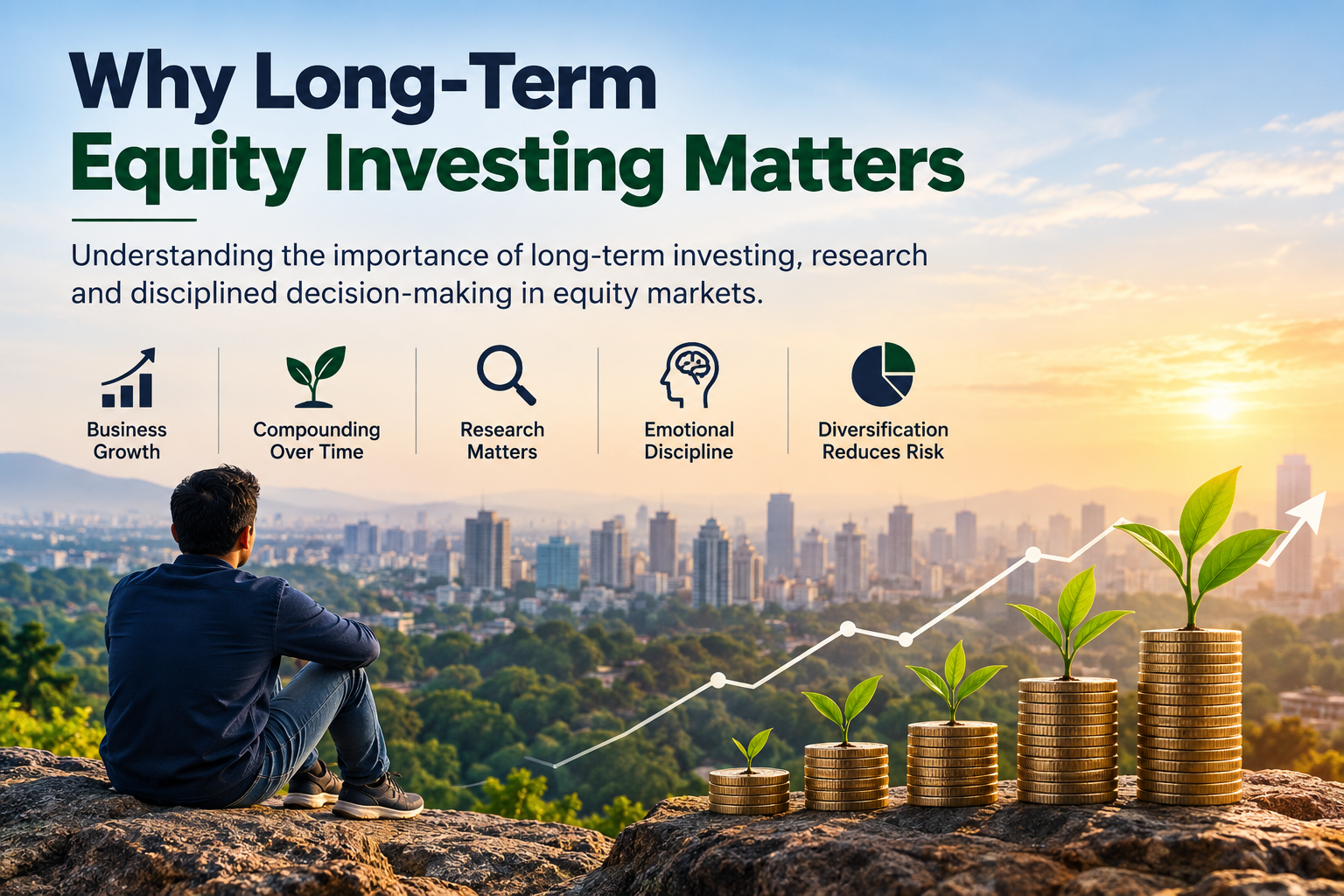
Why Long-Term Equity Investing Matters
Understanding the importance of long-term investing, research and disciplined decision-making in equity markets.
Building wealth through equity investing is not simply about finding the next multibagger stock or predicting what the market will do tomorrow. It is about understanding businesses, making informed decisions, managing risk and allowing time to play its role.
For many investors, the biggest challenge is not entering the stock market. It is staying disciplined when markets become volatile, stock prices fall or short-term opportunities create excitement.
Long-term equity investing offers a different approach. Instead of focusing entirely on daily price movements, investors can focus on business fundamentals, earnings growth, financial strength and their own long-term financial objectives.
However, long-term investing does not guarantee profits. The outcome depends on the quality of investments, the price paid, business performance, market conditions and the investor's ability to manage risk.
What Is Long-Term Equity Investing?
Long-term equity investing means investing in shares of companies with the intention of holding them for an extended period, often several years, based on a carefully considered investment strategy.
When you buy a company's shares, you become a part-owner of that business. Your investment may benefit if the business grows, improves profitability, generates cash flow and creates value for shareholders.
Investors may earn returns through capital appreciation and, where declared, dividends. However, share prices can fall, dividends are not guaranteed and investors may lose part or all of their invested capital.
The central idea is simple: focus on the business behind the stock rather than reacting to every movement in its share price.
1. Time Can Help Businesses Create Value
A strong business does not necessarily become successful overnight. Companies may need years to expand operations, enter new markets, improve efficiency, develop products and strengthen their competitive position.
When a business performs well over time, its earnings and cash flows may grow. If the market recognises this progress, the company's share price may also appreciate.
For example, a company that consistently increases revenue, maintains healthy margins, manages debt responsibly and generates cash may become more valuable over time. However, business growth does not automatically translate into attractive stock returns if the shares were purchased at an excessive valuation.
Investor takeaway: Evaluate how a company can create value over several years, rather than judging it only by its recent share-price performance.
2. Compounding Can Support Long-Term Wealth Creation
Compounding occurs when returns generated by an investment remain invested and may themselves generate additional returns in the future.
In equity investing, compounding can occur when a business grows its earnings and reinvests profits productively, or when investors reinvest dividends and investment gains. Actual results depend on business performance, valuations, market conditions and the returns earned.
Consider a purely illustrative example: an investment of ₹1,00,000 grows at an assumed annual rate of 10%, compounded annually.
| Investment Period | Illustrative Value |
|---|---|
| Initially | ₹1,00,000 |
| After 5 years | Approximately ₹1,61,051 |
| After 10 years | Approximately ₹2,59,374 |
| After 15 years | Approximately ₹4,17,725 |
These figures are mathematical illustrations based on a constant assumed 10% annual return. They are not forecasts, guaranteed returns or representations of actual equity-market performance. Real investment returns fluctuate and can be negative.
The example demonstrates why time can make a difference when returns are positive and remain invested. It also highlights why investors should avoid making financial plans based on unrealistic return assumptions.
3. Long-Term Investing Can Reduce the Pressure to Time the Market
Market prices change every day in response to economic data, corporate announcements, interest rates, investor sentiment and global developments.
Trying to identify the perfect entry and exit point consistently is difficult. Investors who trade frequently may also face additional transaction costs, taxes and the risk of making emotional decisions.
A long-term investment approach can reduce the need to react to every short-term movement. Investors can instead assess whether the original investment thesis remains valid and whether the company continues to meet their expectations.
However, a longer holding period does not guarantee a profit or eliminate the possibility of losses. Buying at an attractive valuation and choosing suitable businesses remain important.
4. Research Matters More Than Market Rumours
Long-term investing should not mean buying a stock and forgetting about it. It requires research before investing and periodic evaluation afterwards.
Before investing in a company, consider the following factors:
- Business model: Understand how the company earns money and what drives demand for its products or services.
- Revenue and earnings: Examine whether growth is sustainable and supported by the underlying business.
- Profit margins: Assess whether the company can maintain or improve profitability.
- Debt levels: Understand the company's borrowing, interest obligations and ability to meet its liabilities.
- Cash flow: Check whether accounting profits translate into actual cash generation.
- Management quality: Evaluate capital allocation, corporate governance and transparency.
- Competitive advantage: Consider what protects the company from competitors.
- Valuation: Compare the share price with the company's earnings, cash flows, growth prospects and relevant peers.
Investors should also understand the risks that could affect the business, including regulatory changes, technological disruption, competition and economic slowdown.
Remember: A good company is not automatically a good investment at every price. Research should examine both business quality and valuation.
5. Market Volatility Is Part of Equity Investing
Equity markets move through different phases. Prices may rise during periods of optimism and fall when investors become concerned about earnings, inflation, interest rates or economic growth.
Even fundamentally strong companies can experience substantial share-price declines. Sometimes the market reacts to temporary concerns; at other times, falling prices reflect genuine deterioration in the business.
During market corrections, investors should avoid making decisions based only on fear. Instead, they can review:
- Whether the company's fundamentals have changed.
- Whether earnings expectations remain realistic.
- Whether the original investment thesis is still valid.
- Whether the current valuation adequately reflects the risks.
- Whether the investment remains appropriate for their financial goals.
Long-term thinking does not mean holding every losing stock indefinitely. If the business deteriorates, governance concerns emerge or the original investment thesis fails, a reassessment may be necessary.
Patience is valuable, but patience without research can become a costly mistake.
6. Diversification Helps Manage Company-Specific Risk
Investing all your money in a single company can expose your portfolio to substantial risk. Even a company that appears strong today can face unexpected challenges.
Diversification means spreading investments across different companies, sectors and, where appropriate, asset classes. It can reduce the impact of poor performance in any one investment, although it cannot eliminate market-wide risk or guarantee against losses.
For equity investors, diversification may involve considering companies with different business models, revenue sources, industries and risk characteristics.
Investors should also consider their overall asset allocation, financial goals, investment horizon and ability to withstand losses.
Those who lack the time or expertise to research individual companies may consider professionally managed or diversified investment options, after evaluating their costs, risks and suitability.
7. Emotional Discipline Can Make a Difference
Investment decisions are often influenced by emotions. Rising prices can create fear of missing out, while falling markets can trigger panic selling.
Other common mistakes include following stock tips without verification, buying simply because everyone else is buying, chasing recent winners and refusing to acknowledge an incorrect investment decision.
A disciplined investor can reduce these risks by following a defined process:
- Set clear financial goals.
- Research the company before investing.
- Decide the role of the investment in your portfolio.
- Assess the potential downside as well as the upside.
- Define the conditions that would invalidate the investment thesis.
- Review the business periodically rather than reacting to every price movement.
- Make changes when supported by evidence, not simply by market excitement or fear.
Independent research and reliable information are more useful than anonymous tips or promises of unrealistic returns. Investors who need personalised advice should consider consulting an appropriately qualified and registered professional.
8. Long-Term Investing Must Match Your Financial Goals
Not every financial goal is suitable for equity investing. The right approach depends on when you need the money, your ability to withstand market losses and your overall financial situation.
Equities can be appropriate for certain long-term goals, but their values can fluctuate significantly even over extended periods.
Money required for near-term expenses or essential commitments generally should not be exposed to risks that could prevent you from meeting those obligations. Investors should maintain appropriate emergency savings and select investments according to their time horizon and risk tolerance.
Before investing, ask yourself:
- What financial goal am I investing for?
- When will I need the money?
- Can I withstand a significant temporary or permanent loss?
- Do I understand the business and the risks involved?
- Is my portfolio sufficiently diversified?
- Am I investing based on research or recent market excitement?
9. When Should You Review a Long-Term Investment?
Long-term investing does not mean ignoring your portfolio. Periodic reviews help determine whether your investments continue to align with your objectives.
Review an investment when important developments occur, such as:
- A material change in the company's business model.
- Repeated deterioration in earnings or cash flow.
- A significant increase in debt or financial risk.
- Changes in management quality or corporate governance.
- Major regulatory or competitive developments.
- A valuation that no longer appears reasonable relative to future prospects.
- A change in your financial goals, time horizon or ability to take risk.
Reviews should be evidence-based. Excessive monitoring of daily price movements can encourage unnecessary transactions, while ignoring meaningful changes can expose investors to avoidable risks.
10. A Practical Framework for Long-Term Equity Investors
A sensible long-term approach combines planning, research, diversification and regular review.
| Stage | What to Focus On |
|---|---|
| Before investing | Financial goals, risk tolerance, business quality and valuation |
| When investing | Position sizing, diversification and investment rationale |
| During market volatility | Business fundamentals, risk assessment and emotional discipline |
| During periodic reviews | Earnings, cash flow, debt, governance and valuation |
| When goals change | Asset allocation, liquidity requirements and portfolio suitability |
The objective is not to predict every market movement. It is to make informed decisions, manage risk and maintain a strategy that fits your financial goals.
Conclusion: Think Beyond Short-Term Market Movements
Long-term equity investing is not about finding a guaranteed winner or assuming that every stock will eventually recover. It is about understanding businesses, investing at sensible valuations, diversifying appropriately and making decisions with a clear financial objective.
Time can support compounding and allow successful businesses to grow, but it cannot compensate for every poor investment decision. Research, risk management and periodic review remain essential.
Before investing, understand what you own, why you own it and what could go wrong.
Research carefully. Stay disciplined. Diversify sensibly. Think long term.
Disclaimer
This article is for educational and informational purposes only and does not constitute personalised investment advice or a recommendation to buy or sell any security. Equity investments are subject to market risks, including the risk of losing capital. Illustrative returns are not guaranteed or predictive of future performance. Investors should consider their financial goals, investment horizon and risk tolerance before making investment decisions.